
GCSE Maths Revision Booklet PDF: A Comprehensive Guide
Navigating GCSE Maths? A comprehensive PDF revision booklet offers focused preparation, mirroring exam content and providing structured learning for optimal success.
What is a GCSE Maths Revision Booklet?
A GCSE Maths Revision Booklet is a concentrated study aid designed to help students prepare for their General Certificate of Secondary Education (GCSE) mathematics examinations. These booklets typically compile key concepts, formulas, and practice questions into a single, portable document – often in PDF format for easy access.
Unlike a standard textbook, a revision booklet focuses specifically on the material most likely to appear in the exam, streamlining the revision process. They act as a focused resource, helping students consolidate their understanding and identify areas needing further attention. Many include worked examples, exam-style questions, and concise explanations, making them invaluable tools for effective self-study and targeted preparation.
Why Use a PDF Revision Booklet?
PDF revision booklets offer unparalleled convenience and flexibility for GCSE Maths preparation. Their digital format allows access on any device – smartphones, tablets, or computers – enabling study anytime, anywhere. This portability is a significant advantage over bulky textbooks.
Furthermore, PDFs are easily searchable, allowing students to quickly locate specific topics or formulas. They often include interactive elements, like clickable links to further resources. The concentrated nature of a revision booklet promotes focused learning, avoiding the overwhelm of larger materials. Cost-effectiveness is another benefit, with many free or affordable options available, making quality revision accessible to all.
Key Topics Covered in GCSE Maths Revision
A robust GCSE Maths revision booklet PDF systematically covers core areas crucial for exam success. Number & Algebra forms the foundation, encompassing topics like fractions, decimals, percentages, and solving equations. Ratio, Proportion & Rates of Change builds upon this, tackling scaling, direct/inverse proportion, and speed-distance-time problems.
Geometry & Measures focuses on shapes, area, volume, and trigonometry. Finally, Probability & Statistics equips students with skills in data analysis, charts, and calculating likelihoods. Effective booklets ensure comprehensive coverage of these key areas, preparing students for diverse question types and maximizing their potential.
Number & Algebra
Number & Algebra within a GCSE Maths revision booklet PDF forms a critical base. Expect thorough coverage of number types – integers, fractions, decimals, and percentages – alongside operations and order of operations (BODMAS/BIDMAS). Algebraic skills are paramount, including simplifying expressions, solving linear and quadratic equations, and working with inequalities.

Revision materials should also address factorisation, expanding brackets, and rearranging formulas. Understanding indices and standard form is vital. A good booklet provides ample practice in these areas, building confidence and fluency for tackling more complex problems encountered throughout the GCSE Maths exam.
Ratio, Proportion & Rates of Change
Ratio and Proportion are frequently tested in GCSE Maths, demanding a solid understanding. A quality revision booklet PDF will detail simplifying ratios, sharing in a given ratio, and direct/inverse proportion problems. Expect clear explanations and worked examples demonstrating how to apply these concepts.
Rates of Change, including speed, distance, and time calculations, alongside density and pressure, should also be covered. Graphical representation of proportional relationships and interpreting rates of change from graphs are essential skills. Practice questions focusing on real-world applications solidify understanding and exam technique.
Geometry & Measures
Geometry & Measures form a significant portion of the GCSE Maths exam. A robust revision booklet PDF will thoroughly cover 2D and 3D shapes, including area, perimeter, volume, and surface area calculations. Expect detailed diagrams and step-by-step solutions for complex problems.
Key topics include angle rules, properties of triangles and quadrilaterals, circle theorems, and transformations (translation, rotation, reflection, enlargement). Furthermore, the booklet should address units of measurement, conversions, and accurate use of mathematical instruments. Practice questions should range in difficulty, preparing students for all exam scenarios.
Probability & Statistics
Probability & Statistics require a solid understanding of data handling and chance. A quality GCSE Maths revision booklet PDF will dedicate substantial space to these areas, beginning with data collection, presentation (charts, graphs), and interpretation. Expect coverage of mean, median, mode, and range, alongside understanding frequency distributions.
Probability concepts like mutually exclusive events, independent events, and tree diagrams are crucial. The booklet should provide clear explanations and worked examples for calculating probabilities. Statistical measures like standard deviation may also be included, alongside understanding bias and sampling techniques. Ample practice questions are vital for mastering these skills.
Finding the Best GCSE Maths Revision Booklet PDF
Locating the ideal GCSE Maths revision booklet PDF requires careful consideration. The market offers a spectrum of resources, ranging from completely free options to premium, paid materials. Free resources can be a good starting point, but often lack the depth and comprehensive coverage of paid booklets.
Prioritize content quality and alignment with your specific exam board. Look for booklets that include detailed explanations, worked examples, and a substantial number of practice questions. Consider the booklet’s layout and readability – a well-organized PDF will significantly enhance your revision process. Don’t hesitate to sample different resources before committing to one.
Free vs. Paid Resources
The choice between free and paid GCSE Maths revision booklet PDFs hinges on individual needs and learning styles. Free resources, readily available online, offer accessible practice and basic concept reviews. However, they often present limitations in content depth, answer key availability, and exam-specific focus.
Paid resources generally provide more comprehensive coverage, detailed explanations, and a wider range of practice questions, including exam-style problems. They frequently include complete solutions and are tailored to specific exam boards. Investing in a paid booklet can be beneficial for students seeking structured, in-depth revision, potentially leading to improved exam performance.
Popular Providers of GCSE Maths PDFs
Numerous providers offer GCSE Maths revision booklet PDFs, catering to diverse learning preferences. Platforms like RevisionWorld and Maths Genie provide extensive free content, including past papers and topic-specific notes. These are excellent starting points for self-directed study.
For more structured, paid options, consider resources from CGP Books, known for their clear explanations and practice questions aligned with major exam boards. Additionally, ExamNinja and Corbettmaths offer comprehensive revision materials, often including video tutorials alongside PDF booklets. Selecting a provider depends on your budget, preferred learning style, and exam board requirements.
Essential Features of an Effective Revision Booklet
A truly effective GCSE Maths revision booklet transcends simple content compilation. It must prioritize clear explanations of core concepts, accompanied by worked examples demonstrating problem-solving techniques. Crucially, ample practice questions with detailed answers are vital for reinforcing understanding and building confidence.

Beyond basic practice, the booklet should incorporate exam-style questions mirroring the format and difficulty of the actual GCSE exam. Features like topic summaries, formula sheets, and clearly identified key skills further enhance its value. A well-structured booklet empowers students to identify weaknesses and focus their revision efforts strategically.
Clear Explanations & Examples
Demystifying complex mathematical concepts is paramount. A superior GCSE Maths revision booklet doesn’t just present formulas; it provides crystal-clear explanations of the underlying principles. These explanations should be concise, accessible, and avoid unnecessary jargon, catering to diverse learning styles.
Illustrative examples are equally crucial. Each concept must be accompanied by step-by-step worked examples, demonstrating how to apply the theory to solve problems. These examples should progressively increase in difficulty, building student confidence and solidifying their understanding. Visual aids, like diagrams and graphs, further enhance comprehension.
Practice Questions with Answers
Reinforcement through practice is key to mastering GCSE Maths. An effective revision booklet will be brimming with a diverse range of practice questions, carefully designed to test understanding of each topic. These questions shouldn’t just replicate textbook examples; they should challenge students to apply their knowledge in novel situations.
Crucially, detailed answers must be provided for every question. These answers shouldn’t simply state the final result; they should showcase the complete working, allowing students to identify any errors in their approach and learn from their mistakes. A variety of question types is also essential.
Exam-Style Questions
Bridging the gap between practice and performance requires exam-style questions. A quality GCSE Maths revision booklet won’t shy away from mirroring the format, wording, and difficulty level of actual GCSE exam papers. These questions should encompass multi-step problems, requiring students to synthesize knowledge from various topics.
Realistic time constraints are also vital; simulating exam conditions builds crucial time management skills. Detailed mark schemes, mirroring those used by examiners, are essential for self-assessment. Students need to understand how marks are awarded, not just what the correct answer is, to maximize their potential.
Utilizing a GCSE Maths Revision Booklet Effectively
A revision booklet is a tool, not a magic wand. Maximizing its impact demands a strategic approach. Begin by crafting a realistic revision schedule, allocating specific time slots for each topic based on individual strengths and weaknesses. Don’t just passively read – actively engage with the material!
Employ techniques like active recall – testing yourself without looking at the answers – and spaced repetition, revisiting topics at increasing intervals. This strengthens memory retention. Regularly attempt practice questions, analyzing errors to pinpoint areas needing further attention. Consistent, focused effort yields the best results.
Creating a Revision Schedule
A well-structured schedule is paramount for effective revision. Begin by identifying all key topics within your GCSE Maths syllabus, referencing your revision booklet’s content. Allocate time proportionally to each topic’s weight in the exam and your personal proficiency. Prioritize weaker areas, dedicating more focused study time to them.
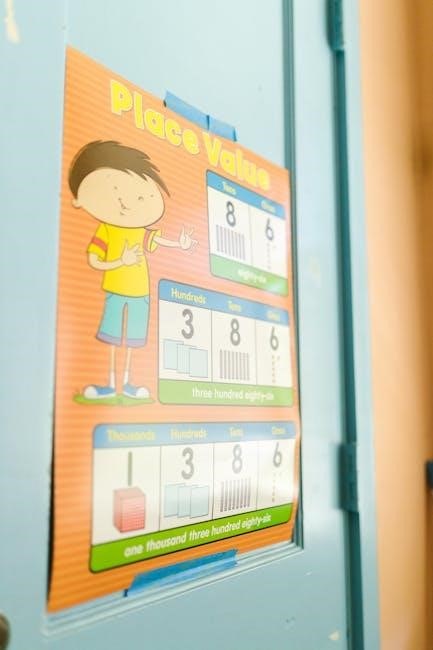
Break down large tasks into smaller, manageable chunks. Incorporate regular breaks to prevent burnout and maintain concentration. Be realistic – avoid over-scheduling. A balanced schedule, integrating revision with other commitments, is crucial for sustained effort and optimal performance. Review and adjust your schedule weekly based on progress.
Active Recall & Spaced Repetition
Maximize learning with active recall and spaced repetition. Instead of passively re-reading your GCSE Maths revision booklet, actively test yourself. Use practice questions – the booklet should provide plenty! – and attempt to solve them without looking at the solutions first. This strengthens memory retention.
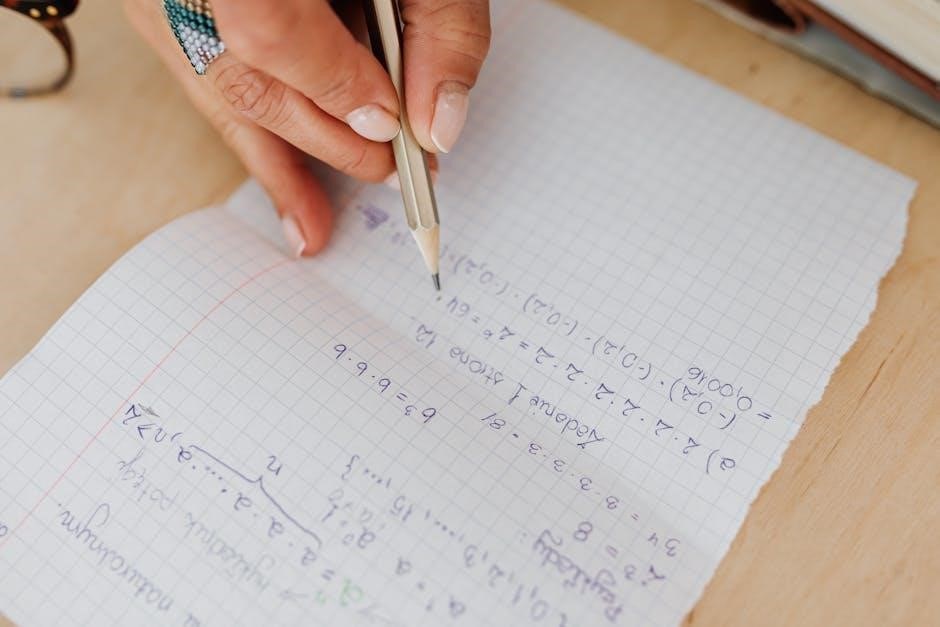
Spaced repetition involves revisiting topics at increasing intervals. Don’t cram! Review material shortly after learning it, then again a few days later, then a week, and so on. This combats the forgetting curve and solidifies understanding. Your revision booklet facilitates this by allowing focused practice on specific areas over time.
Beyond the Booklet: Additional Revision Resources
A GCSE Maths revision booklet is a fantastic starting point, but don’t limit yourself! Supplement your learning with online maths platforms and websites offering interactive exercises and video tutorials. These can explain concepts in different ways, catering to various learning styles.
Crucially, utilize past papers and mark schemes. These provide invaluable insight into exam expectations and question formats. Practicing with real exam papers builds confidence and helps you refine your exam technique. Analyze your mistakes using the mark schemes to identify areas needing further attention – revisiting those sections in your booklet!
Online Maths Platforms & Websites
Numerous online resources complement your GCSE Maths revision booklet. Platforms like Khan Academy offer free video lessons and practice exercises covering a wide range of topics, ideal for reinforcing understanding. BBC Bitesize provides concise revision notes and interactive quizzes, perfect for quick knowledge checks.

Consider websites offering personalized learning paths. These adapt to your strengths and weaknesses, focusing on areas where you need the most support. Many platforms gamify the learning process, making revision more engaging and motivating. Explore options to find what best suits your learning preferences and exam preparation needs.
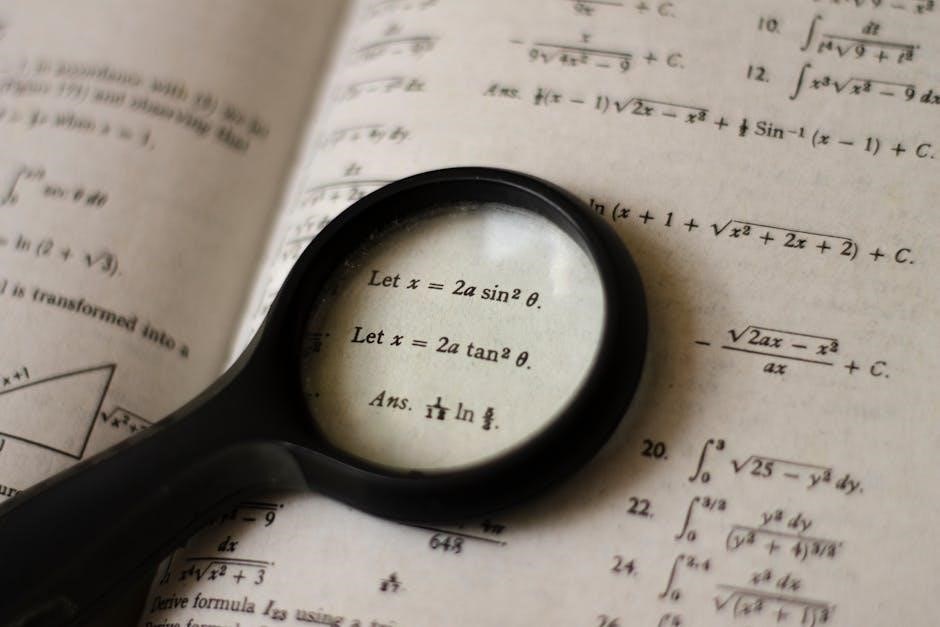
Past Papers & Mark Schemes
Utilizing past papers is crucial for effective GCSE Maths revision. They familiarize you with the exam format, question styles, and time constraints, building confidence and reducing anxiety. Access past papers from the AQA, Edexcel, and OCR websites – the main exam boards.
Critically, always review the corresponding mark schemes. These demonstrate how examiners award marks, revealing the key concepts and methods they’re looking for. Analyzing your mistakes on past papers, guided by the mark scheme, pinpoints areas needing further attention. This targeted approach maximizes your revision efficiency and potential for success.
Common Mistakes to Avoid During Revision
Effective revision requires mindful strategies. A common pitfall is rushing through topics, prioritizing breadth over depth. Ensure a solid understanding of fundamentals before moving on. Equally detrimental is ignoring weak areas; confronting these challenges is vital for overall improvement.
Avoid passive reading; actively engage with the material through practice questions. Don’t solely rely on memorization – focus on understanding the ‘why’ behind the methods. Finally, neglecting regular breaks leads to burnout and reduced retention. Consistent, focused study sessions are far more productive.
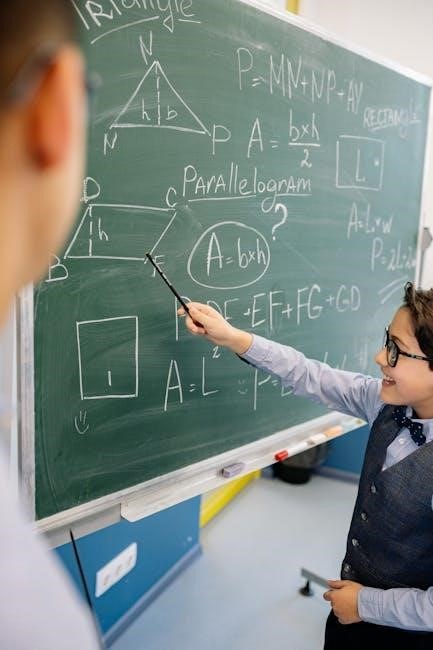
Rushing Through Topics
A frequent error in GCSE Maths revision is attempting to cover too much ground too quickly. This often results in superficial understanding, hindering genuine problem-solving skills. Students may skim through examples without internalizing the underlying concepts, leading to difficulties when facing unfamiliar questions.
Prioritize depth over breadth. It’s more beneficial to master a few key topics thoroughly than to superficially review everything. Allocate sufficient time to each area, ensuring you can confidently apply the techniques. Resist the urge to simply tick off topics; true revision demands active engagement and solid comprehension.
Ignoring Weak Areas
A common pitfall during GCSE Maths revision is neglecting areas where you struggle. It’s tempting to focus on topics you already understand, providing a false sense of security. However, this approach leaves significant gaps in your knowledge, potentially leading to substantial mark losses in the exam.
Actively identify and address your weaknesses. Use practice questions and past papers to pinpoint areas requiring improvement. Dedicate extra time and effort to these topics, seeking help from teachers or tutors if needed. Confronting challenging concepts head-on is crucial for building a robust understanding and maximizing your potential.

Future Trends in GCSE Maths Revision Materials
The landscape of GCSE Maths revision is evolving rapidly. Expect increased integration of interactive elements within PDF booklets – think embedded videos, self-checking quizzes, and dynamic diagrams. Personalized learning paths, adapting to individual student needs based on performance data, will become more prevalent.
Augmented reality (AR) and virtual reality (VR) may offer immersive learning experiences, visualizing complex concepts in 3D. AI-powered tools could provide tailored feedback and identify knowledge gaps with greater precision. Gamification will continue to rise, transforming practice into engaging challenges, boosting motivation and retention.
Be First to Comment